ABC News
Deception PointABC News is a major news organization whose Washington newsroom becomes a practical crossroads in the novel’s political and scientific crisis. Its production floor offers Gabrielle Ashe access to a trusted colleague and a route toward information about NASA’s disputed PODS account; at the same time, the novel places ABC among the live broadcasters the White House can enlist to carry a presidential announcement worldwide. The organization therefore appears both as a workplace where reporting is pursued and as part of the communications infrastructure through which official narratives acquire an audience.
Newsroom and access
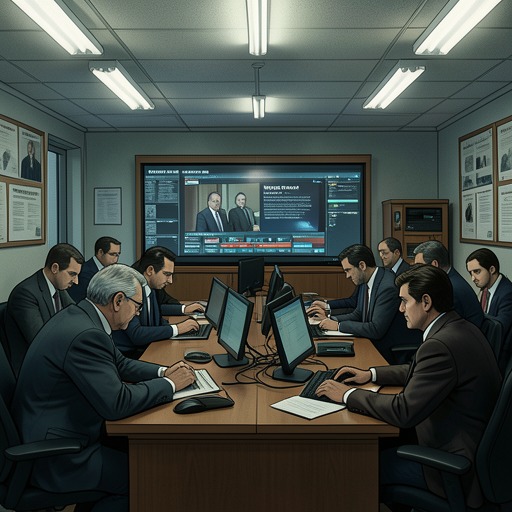
Gabrielle enters ABC News’s third-floor production room at a run, arriving amid a scene of continuous, high-pressure work. Editors call across cubicles, reporters move between desks comparing faxes, and interns shuttle through the crowded floor. The room is presented not as a quiet institutional backdrop but as a place where information is being sorted, contested, and acted upon in real time.
Gabrielle has come to see Yolanda Cole, her trusted friend, who is working out on the production floor rather than in one of the glass-walled private offices. The friendship gives Gabrielle a personal point of access within the newsroom: she can move from the public commotion into Yolanda’s glass cubicle and speak candidly. The physical change in setting—from the hectic floor to a private workspace—marks the difference between the newsroom’s visible urgency and the confidence required for Gabrielle’s disclosure.
In that conversation, Gabrielle tells Yolanda about her one-night affair with Sedgewick Sexton and the photographs Marjorie Tench has obtained. Yolanda’s response is notably unshockable; she says she had suspected the affair and counsels Gabrielle not to panic about the photographs. Her reaction does not erase the political danger, but it establishes the friendship as a counterweight to the pressure Tench has applied. Yolanda also argues that the White House has tried to turn Gabrielle against Sexton, encouraging her to keep faith with the candidate rather than suddenly trust Tench.
Gabrielle’s pursuit of the PODS story
Later, the newsroom becomes the starting point for Gabrielle’s attempt to verify allegations that NASA lied about PODS. Standing at Yolanda’s desk, she recognizes that the issue has changed in significance: a press conference she had watched weeks earlier had seemed odd, but she had not treated the software account as central. Now Sexton needs information quickly, and Gabrielle has promised to help him obtain it. The difficulty is that the supposed informant she had offered him is Tench, who will not assist her; Gabrielle must find another route.
That search takes Gabrielle from ABC News to NASA headquarters, where she enters a crowded lobby filled with media crews and NASA personnel. The transition makes the newsroom’s role concrete: ABC is not where the technical evidence is settled, but it is where Gabrielle can recognize a developing story, decide that the old explanation needs checking, and begin pursuing the people who might know more. Her reporting effort leads her toward Chris Harper and the account of PODS’s anomaly-detection software failure, separating the existence of a system failure from the later public claim that the problem had been resolved.
The contrast between the newsroom and NASA’s headquarters also clarifies the limits of access. At ABC, Gabrielle has Yolanda’s friendship and the momentum of a newsroom in motion; at NASA, she is an outsider without a press pass or an agency identification badge, moving through a lobby where television crews compete for attention. ABC’s importance here lies less in institutional omniscience than in the human and professional connections that let Gabrielle turn an allegation into a line of inquiry.
The broadcast network and presidential communication
ABC News also belongs to a much larger media system that the White House Communications Office can activate during an emergency. The office’s distribution plan includes broadcast, print, radio, and online outlets, with live-feed-capable organizations such as CNN, NBC, ABC, and CBS promised free live television feeds. Fax broadcasts, mass email, telephone announcements, and a breaking-news webpage are designed to interrupt whatever those outlets are carrying and redirect attention to the President.
In this arrangement, ABC appears alongside other national and international news sources as a channel through which presidential communication can reach the public at scale. The White House is not merely issuing a statement and waiting for coverage; its staff prepares a coordinated release and works to make the address difficult for broadcasters to ignore. The organization’s presence in that list underscores how political power depends on access to distribution, even though the available evidence does not describe ABC’s editorial decisions about the announcement.
This broad communications role stands beside the more local, character-driven use of ABC’s production room. In one strand, Gabrielle relies on a colleague and pursues a contested technical story; in the other, the network is one component in a government-managed effort to deliver a presidential message. The contrast preserves a distinction between a newsroom as a place where information is investigated and a broadcaster as a conduit that can carry official speech. The novel connects the two without treating them as identical.
Narrative significance
ABC News links private vulnerability to public information. Gabrielle’s disclosure to Yolanda brings the Sexton affair and Tench’s photographic leverage into a trusted, offstage conversation; Gabrielle’s later work at the desk turns her attention toward the PODS allegations and the need for independent information. The organization’s newsroom thus gives political news a human setting: a friendship can steady a source, while a developing story demands that she test what she has been told.
The network’s appearance in the White House distribution plan widens that function from individual reporting to mass communication. A presidential address can be arranged as an event capable of preempting ordinary programming, while the scientific and political claims at stake remain subject to investigation and correction. ABC News is not shown as the arbiter of truth or as an actor with a single, established political position. Rather, it occupies the consequential space between claims and audiences: a place where a reporter can pursue a lead, and a channel through which national leaders seek to define what the public hears.